

At a Glance:
- What it really means to integrate another system with Automic.
- How Automic coordinates work across cloud platforms, data tools, enterprise applications, and infrastructure.
- A closer look at the Kubernetes and Apache Airflow integrations.
- Explore the Automic Integration Brochure for the larger list.
Yes, Automic runs CMD jobs. It does that very well.
But if that’s all you’re using it for, you’re leaving a lot on the table.
Today, a single business process might touch an ERP system, a data pipeline, a cloud service, a container platform, and three other applications before anyone has finished their first cup of coffee. Every one of those tools may work perfectly on its own. The challenge is getting them to work together in the right order.
That’s where Automic comes in.
Automic Orchestrates the Work
Automic isn’t replacing Airflow, Kubernetes, Databricks, Oracle, SAP, or your cloud platform. Those systems still do what they were built to do.
Automic sits above them and coordinates the work.
It can start a process, pass information to the next step, wait for that step to finish, enforce dependencies, retrieve status and logs, and decide what should happen next.
That’s the difference between launching a job and orchestrating an end-to-end business process.
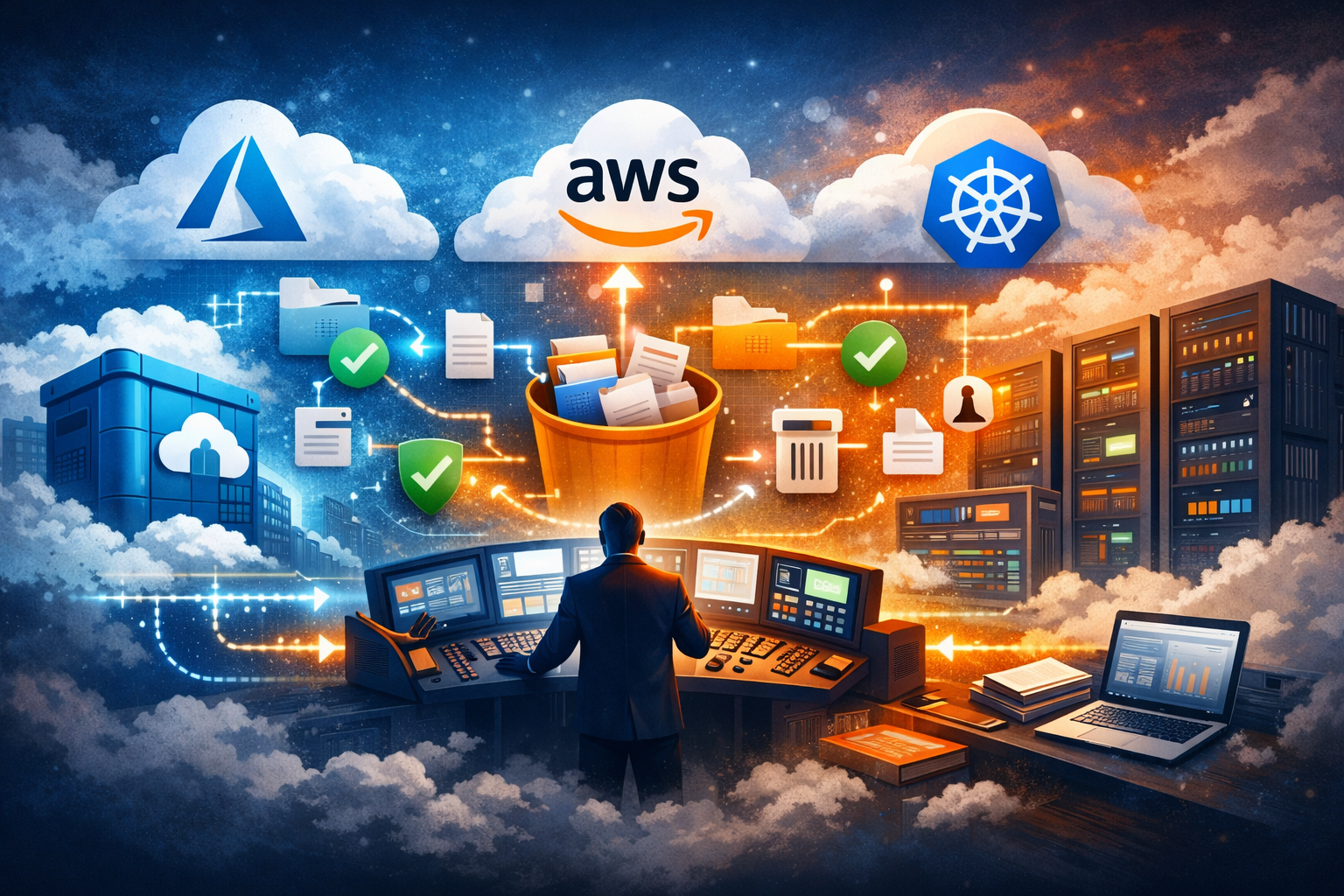
For example, a process could begin in Oracle Fusion, trigger work in a cloud platform, wait for an Airflow DAG to finish, refresh a Power BI report, and then notify the next team. Automic keeps track of the entire chain.
Without that orchestration, each system can be working exactly as designed while the overall process is completely stuck. That usually leads to several teams joining a call to determine which perfectly healthy system is responsible. Always a great use of everyone’s morning.
Where the Integrations Come From
Many of these connections are available through prebuilt integrations and Action Packs in the Broadcom Automation Marketplace.
That means you don’t necessarily have to create a new custom script every time two systems need to work together. The integrations give Automic a defined way to interact with the tools already running your business.
The list covers a lot of ground:
- Cloud platforms and services: AWS, Microsoft Azure, and Google Cloud
- Data and analytics: Apache Airflow, Apache Kafka, Databricks, dbt, Informatica, and Power BI
- Enterprise applications: Oracle Fusion Cloud ERP, Oracle EPM, Oracle Cloud Infrastructure, SAP S/4HANA, SAP BTP, and SAP BusinessObjects
- Infrastructure and automation: Kubernetes, Ansible Tower, Cloud Foundry, VMware Aria, and OpenSSH
And that’s still not the complete list. Broadcom put the broader catalog into this Automic Integration Brochure, so you can see what’s available without going on a scavenger hunt.
What Automic Can Do with Kubernetes
Containers are great. Managing all the work happening inside them at scale is where things get interesting.
With the Kubernetes integration, Automic can schedule, run, and monitor Kubernetes jobs through completion. It can also scale Deployments and StatefulSets, execute commands inside pods, and use values from your Automic workflows.
The Kubernetes platform still runs the containers. Automic makes the containerized work part of the larger enterprise process.
That matters when a Kubernetes job is only one step in something much bigger. Instead of hoping every team notices when its portion is ready, Automic manages the dependencies and keeps the process moving.
What Automic Can Do with Apache Airflow
Data teams use Airflow to build and manage data pipelines. The problem is that those pipelines can become their own isolated world while the rest of the business process happens somewhere else.
Automic can trigger and schedule Airflow DAGs, monitor them through completion, and bring their status and logs back into the broader workflow.
That means an Airflow task can depend on work completed in another application, and another enterprise process can wait for the Airflow DAG before continuing.
Airflow remains Airflow. Automic gives you one place to coordinate it with everything else.
Why Automic's Integrations Matter
The real value isn’t that Automic connects to one more application. It’s that Automic can coordinate work across many different applications as one process.
You get a clearer view of:
- What is running
- What has finished
- What is waiting
- Which dependencies have been met
- Where something failed
- What needs to happen next
That’s a lot more useful than having six tools report that everything looks fine while the business process quietly sits there doing absolutely nothing.
See What Automic Can Connect
The real value isn’t that Automic connects to one more application. It’s that Automi
Broadcom created the Automic Integration Brochure to give you a straightforward look at the cloud services, data platforms, enterprise applications, and infrastructure tools Automic can bring into one coordinated workflow.
Explore the Automic Integration Brochure
If you see something on the list and want to know how it could fit into your environment, talk to us. We’ve spent a lot of time getting very different systems to behave like they’re all on the same team.