


AT A GLANCE
- Broadcom’s Unified Automation Strategy: Broadcom is tackling cloud chaos and decentralized automation. It is prioritizing Unified Observability, Multi-Cloud Orchestration, and Automation Intelligence. This will create a centralized, efficient automation framework for enterprises.
- Generative AI-Driven Workload Automation: AI is simplifying automation. It enables natural language script creation, self-healing workflows, and smart SLA management. This makes Workload Automation easier and more efficient for business users.
- AutoSys & Automic’s shift to agentless automation: Broadcom is reducing agent dependencies. They are enhancing AutoSys and Automic SaaS. This includes self-service automation, auto-scaling, and containerization. These changes will cut operational overhead and boost efficiency.
- Orchestration & API Overhaul for Seamless Integration: Broadcom’s new REST APIs and cloud-native job orchestration enable faster, cheaper automation in hybrid and multi-cloud environments. Their expanded integrations with Kubernetes, OpenShift, and ERP systems support this.
FULL TEXT

Over the last year, Broadcom’s been on a mission to deliver innovation, integrations, and business impact, and Rajeev Kumar, Head of Product Management – Automation | Broadcom, gave a spiffy briefing about their R&D roadmap at the 2024 Broadcom’s Automation Virtual Summit.
First off, I think of Broadcom as the overachieving kid in the class.
They’ve been on a roll with R&D innovations (ohh by the way, Broadcom spends $5 billion on this), and we know many of you have already put these to good use, transforming your operations. A big shout-out to everyone who contributed with ideas, design validation, and beta testing.
And before we get into the meat of it, the all-important-disclaimer:
Everything in this summary is subject to change, so reach out to RMT if you want help building a concrete roadmap.
The high-level scoop on Broadcom Automation
- Broadcom jazzed up the Automation Marketplace with over 60 integrations spanning cloud, ERP, and data analytics – it’s a tech buffet, and you’re invited!
- Automation observability, with Airflow and enhanced data insights, is picking up speed.
- Automic SaaS is officially live, with multiple customers already enjoying the benefits – it’s the Bobfather’s 5 star restaurant experience.
Now, here’s the whirlwind tour.

The Chaos of 2 Colliding Automation Trends and Broadcom's Response
Trend 1: Rapid Cloud Adoption
Cloud adoption is skyrocketing faster than a viral cat meme.
According to recent surveys, over 51% of enterprise infrastructure spending is now devoted to public cloud and SaaS applications.
While cost concerns are making everyone a little jittery (hello, FinOps!), and compliance worries lurk under the bed, these issues aren’t slowing down the cloud party – at least not yet.
We’re seeing a shift towards a hybrid and multi-cloud landscape, highlighted in the Flexera 2024 State of the Cloud Report, which reveals that over three-quarters of orgs adopting cloud are embracing a mix of hybrid and multi-cloud.
Everyone is piling their plates high on this buffet.

Trend 2: the Decentralization of the Automation Center of Excellence
Another trend is a shift in automation responsibilities. We see a shift to a more decentralized and self-service-driven approach.
Now, business units are calling the shots on what gets automated, who does the automating, and which technologies to use – basically, they’ve become the DIY experts of the automation world.
Sure, Automation Centers of Excellence exist in various forms, but often their role feels like that of a maintenance crew just keeping the automation platform running. They aren’t exactly stepping up to lead the charge in building a widespread automation culture across the enterprise.
Right?
Meanwhile, lines of business and application teams are all about speed and scale when it comes to automation. They’re focused on specific use cases and don’t have the time or inclination to dive into tool-specific training or invest in specialized automation skills.
Instead, they’re opting for use case-specific technologies that deliver quick results – they want the instant ramen from the microwave.

Cloud Chaos and Automation Anarchy: An IT Comedy of Errors
When you mix rapid cloud adoption with a decentralized approach to automation, you end up with a recipe for chaos – think of it as a tech jamboree gone wild!
The array of technologies and automation tools creates a delightful mess for IT operations.
The Cloud Team? They’re missing SLAs and watching costs balloon as they juggle data between Apache Airflow, Google Cloud Composer, Kubernetes, and Azure Logic Apps. It’s like trying to perform a magic trick while balancing on a unicycle!
Meanwhile, the On-Premise App Teams are on a scavenger hunt for the root cause of failures, attempting to connect the dots between SAP, Informatica, Kubernetes, and Oracle. Spoiler alert: they’re not finding much, just a lot of confusion!
The infrastructure team is feeling the heat too. They’re battling increased production risks and slower adoption because they’ve got more apps than they know what to do with – Google Cloud Platform, Microsoft Azure, Red Hat Ansible, and AWS are all in the mix. It’s like a reality show where nobody knows who’s getting voted off next!
The data pipeline crew? They’re suffering from a severe case of “too many tools, not enough control,” bouncing between Kafka, Azure Data Factory, and Informatica like they’re on a merry-go-round.

When things go awry in this chaotic automation jungle, it impacts costs, compliance, and ultimately drags down the speed of automation and scalability.
The IT Ops Teams, bless their hearts, are trying to hold everything together, but without end-to-end visibility, they’re stuck in the slow lane of failure repairs. These little hiccups in the chaotic landscape can snowball into higher costs and even lost business.
In short, if you combine cloud chaos with automation disarray, you get an IT operation that’s trying to run smoothly while riding a rollercoaster – good luck with that!

Navigating the Trending Chaos: A Three-Step Approach to Streamlined Automation
So, how do we transform these chaotic, multi-vendor automation islands into a streamlined operation? The answer lies in adopting a platform approach to automation and orchestration, which connects these islands and offers centralized visibility and control.
Here’s the three-step game plan:
- Unified Observability
- Multi-Cloud Orchestration
- Automation Intelligence
Let’s dive into the details!

Streamlining Automation: A Collaborative Command Center in Action
Now it might sound like a tech jargon party that invited all the buzzwords, but take a closer look.
Unified Automation Observability is all about shining a spotlight on the entire automation landscape, giving you a clear view of business processes across everything from ancient mainframes to the latest cloud wonders. Think of it as a central command center where you can keep an eye on all your automation activities without needing a map or a treasure hunt!
Now, End-to-End Orchestration is where the magic happens. It knits together data and processes in a hybrid or multi-cloud environment. The approach not only centralizes control but also adds some serious auditability bling.
And Automation Intelligence is basically your automation fairy godmother. It uses data and analytics to help you make smarter decisions. It spots processes that frequently trip over their own shoelaces and need a little optimization love, boosting SLA compliance and speeding up the business process.
So, by embracing this three-step plan, chaotic islands of automation can become a sleek, efficient, and intelligent ecosystem.

Broadcom's 5-Pronged R&D Approach: Where Fun Meets Function
Broadcom’s got a five-fingered strategy for their R&D investments, and it’s more organized than your sock drawer. Here’s the scoop:
Orchestration and Connectivity: Think of it as the conductor of an automation symphony – keeping all those tech instruments in tune and working together.
Automation Observability and Intelligence: This is all about monitoring everything in the automation playground, making sure no one’s off the swings without a helmet.
Developer and Operator Experiences: They’re rolling out a user-friendly experience for business users, so even the least tech-savvy can automate without feeling like they’re climbing Mount Everest.
Platform Simplification and TCO Optimization: They’re making deployment easier than ordering pizza, which means lower costs and quicker results.
Robust Stability, Reliability, Security: This one’s crucial! They’re investing in making sure everything runs as smoothly as butter on a hot pancake, with a focus on security and performance.
So, with this five-step dance, Broadcom is turning chaotic automation into a well-choreographed routine!

Broadcom's Orchestration and Connectivity: Making Integration Fun
Under the orchestration and connectivity theme, Broadcom is focused on three things:
- A buffet of integrations
- API orchestration that’s easier than ordering takeout
- Supercharged job orchestration capabilities – because who doesn’t want their jobs to run smoother than a buttered slide?
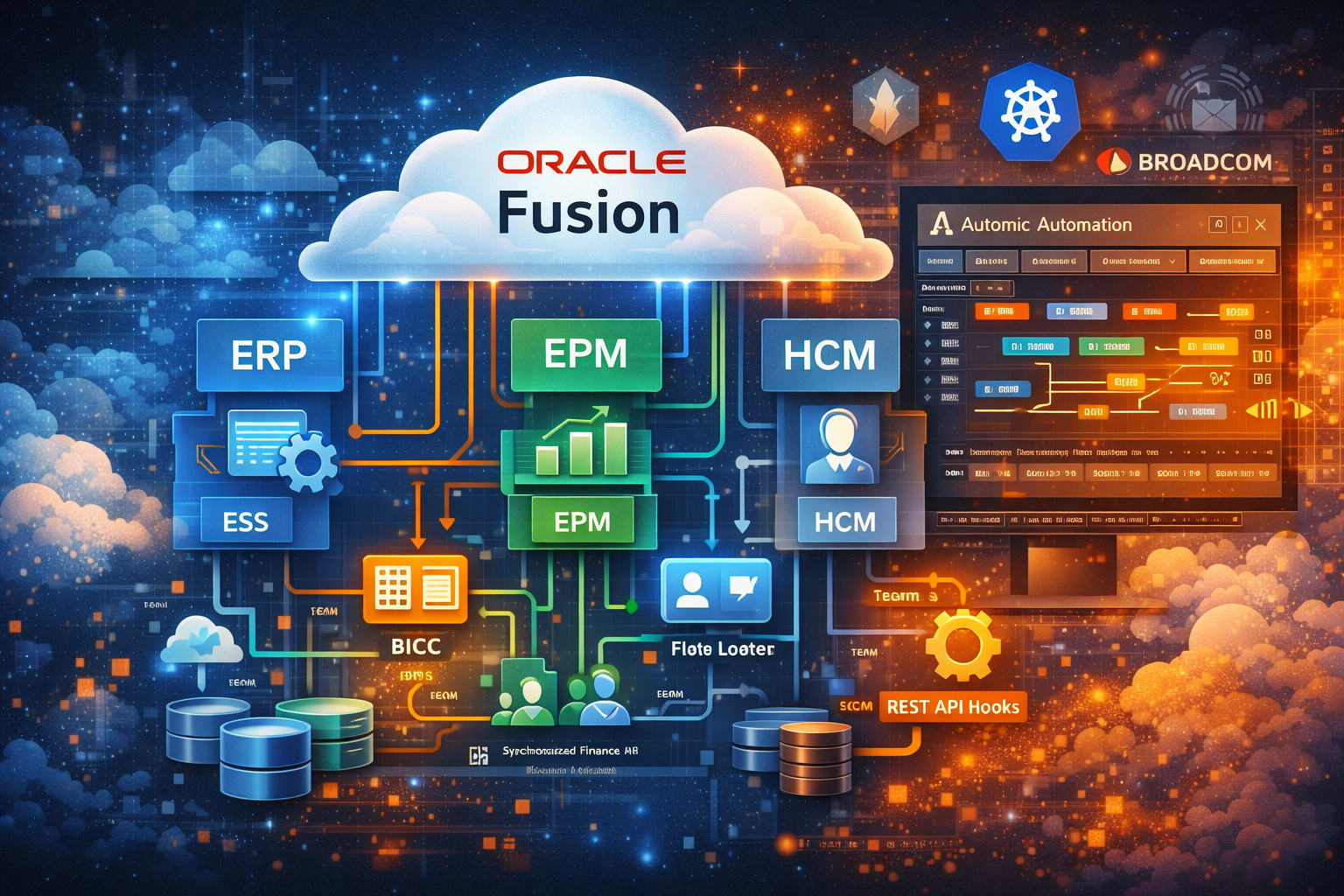
If you haven’t checked out the Automation Marketplace yet, do yourself a favor, click this link: “Broadcom Automation Marketplace” and dive in! They’ve packed it with hundreds of integrations, and just last year alone, they added 61 fresh options for cloud, ERP, data analytics, and container orchestration technologies like Kubernetes and OpenShift.
The hot sellers? Cloud storage and ERP integrations are flying off the shelves, with Kubernetes-related integrations driving the downloads like it’s Black Friday.

Broadcom's API Overhaul for Automic: From Java to Joy
Broadcom is on a mission to make API orchestration more smooth by
(1) adding New REST APIs – Automic is getting modernized Java APIs,
(2) planning a future ghosting of Java APIs by designing and building new REST APIs, and
(3) creating better API orchestration that allows for status-folding coupled with additional modern API security methods to use while they finish up building the new APIs.
AutoSys Enhancements: Jobs That Actually Talk to Each Other
AutoSys is also getting a glow-up! With new enhancements, jobs can communicate directly, eliminating the need for workarounds.

Enhancing AAI Automation: Focus Areas for 2025
AAI’s automation observability and intelligence capabilities will extend in 2025 with new dashboards and data insights tailored for business users.
Broadcom aims to enhance SLA management to handle multiple SLAs and calendar-based SLAs effectively.
They’re also prioritizing simplification of the platform and deployment for AAI overall.

Harnessing Generative AI for Enhanced Workload Automation
Generative Artificial Intelligence (Gen AI) is a hot tech trend that can’t be ignored. Gen AI is useful because it can create new content based on user requests.
While organizations are eager to use it, many struggle with messy data scattered across various tools. This is where Workload Automation steps in to help orchestrate and clean up that data, ensuring it’s ready for action.
Generative AI can simplify automation by letting users create scripts and workflows with just a few natural language prompts – no coding PhD required.
It also boosts monitoring and SLA management by streamlining root cause analysis and enabling self-healing workflows.
For generative AI to shine, it needs clean, compliant data fed through robust data pipelines.
Central Workload Automation orchestration will play a crucial role in this journey, empowering users with conversational AI that guides them through the automation process.
Related: What the Google Presentation on AI for Workload Automation

Enhancing AutoSys and Automic with Conversational AI
The Knowledge Assistant is a standout feature in AutoSys and Automic, leveraging conversational AI to help users effortlessly find answers. You may also have used it in AAI 6.5.3 or later.
The AI assistant takes natural language prompts – ask it a question, and it provides concise, relevant responses pulled from multiple knowledge sources.
Not only does it deliver text, but it also brings in videos and other formats, making knowledge accessible and engaging. You can even customize it to point to your own data sources for tailored insights.
For example, if you ask, “Schedule this job on the last day of the month, avoiding holidays,” the assistant can generate the dates and handle the setup – all while simplifying complex automation tasks like notifications and error handling.
This innovation extends to operations, enabling operators to gather insights quickly, summarize logs, and perform root cause analysis with ease.

Revamping the Operator Experience in AutoSys
Broadcom is embarking on a complete redesign of the operator experience for AutoSys. The goal? To streamline user journeys by cutting down the number of clicks, allowing users to access relevant insights quickly. They’re also integrating a touch of generative AI to boost workflow efficiency.
As they move forward, the focus will extend beyond just operators to enhance the experiences of developers and administrators within AutoSys Workload Automation.

Elevating AutoSys and Automic SaaS through the Automation Center of Excellence
The Automation Center of Excellence primarily focuses on deploying, maintaining, and managing automation platforms.
While these tasks are essential, the true value lies in empowering your seasoned experts to foster an automation mindset across the enterprise.
They can significantly enhance the automation efforts of business units and application teams while ensuring proper governance is in place.
To achieve this, it’s crucial to relieve these professionals from routine tasks like deployment, patching, and monitoring.
Automic SaaS is a pivotal step in this direction.
Additionally, Broadcom is investing in AutoSys containerization and an agentless experience that will free up valuable time for administrators and reduce overall costs.

Enhancing AutoSys and Automic Self-Service with Agentless Automation
One of the challenges line-of-business users face is the deployment and maintenance of agents. While this option will remain available, efforts are underway to create a truly agentless experience for users of automation.
The team is experimenting with designs that allow for agent deployment, configuration, and auto-scaling as integral features of the core automation platform itself.
This initiative aims to boost self-service capabilities significantly and facilitate greater adoption of the AutoSys and Automic platforms by business units and application teams in 2025 and beyond.

Transforming Automation: Pervasive Orchestration and Visibility
To summarize, Broadcom is excited about orchestration. Excited about automation visibility.
To turn this vision into reality, significant investments are being made in improving orchestration and connectivity, including the addition of dozens of integrations, enhanced APIs, and simplified processes.
They are expanding automation observability with more data insights and user-friendly dashboards tailored for business users, which will enhance self-service capabilities and make tools more relevant for stakeholders.
User experience is also a priority, with redesigned interfaces and the incorporation of generative AI technologies to enable more users to automate with shorter learning curves.
Simplifying the platform and reducing the total cost of ownership is key to freeing up resources in the Automation Center of Excellence, allowing for a focus on strategic automation initiatives.
In this regard, operational overhead will reduce greatly with Automic SaaS, an agentless experience, and the ability to run AutoSys and AAI on PostgreSQL or containerized platforms.
Want to know more? Reach out to my team.
Say Bob sent you.
Over.







You must be logged in to post a comment.